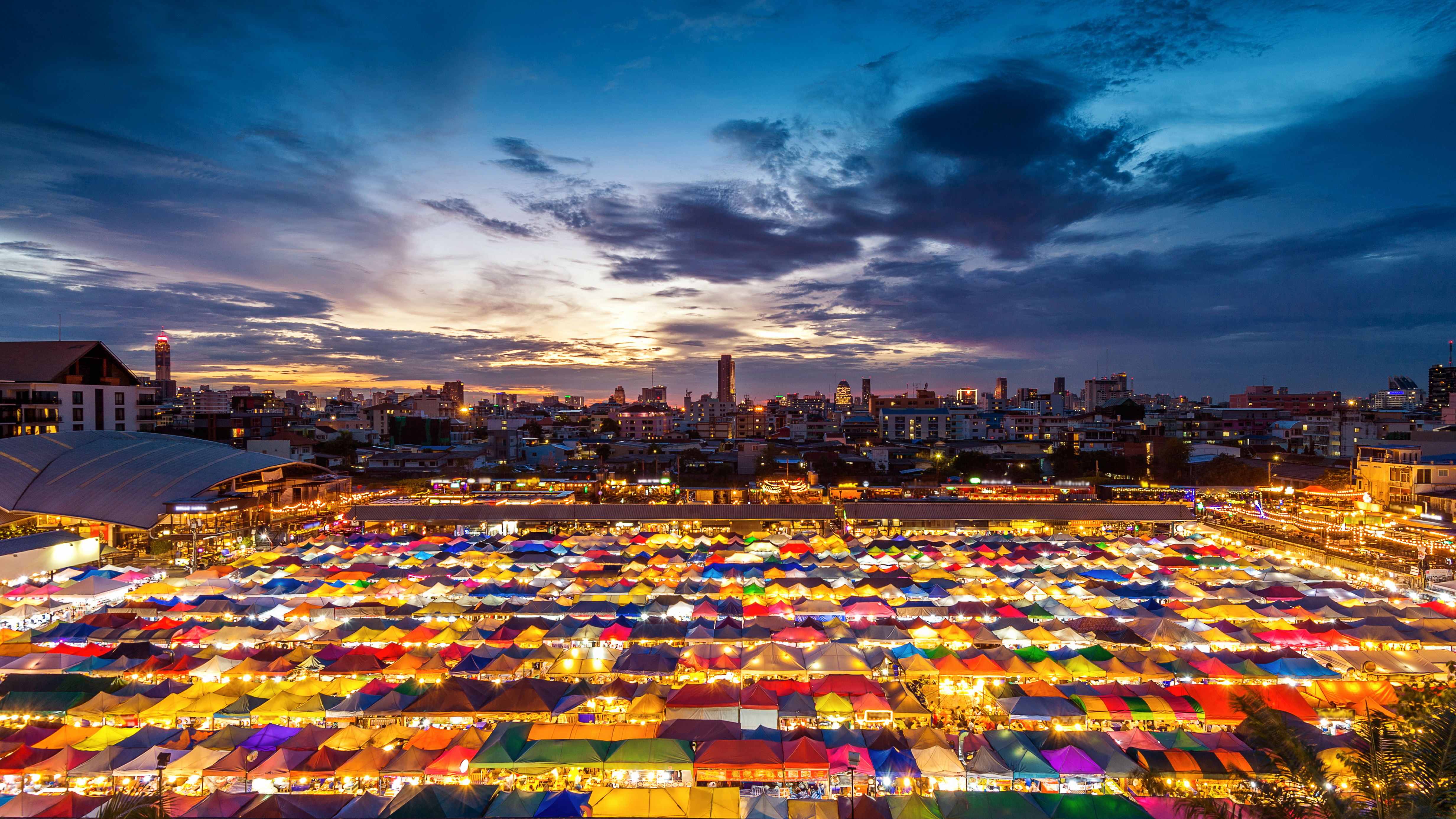
Thailand: culture, commerce, and the architecture of entry
What Thailand's commercial architecture means for founders who want to build there.
There is a particular moment that happens in Thailand, usually in the first week, when the country stops feeling like a market and starts feeling like a system. You notice it in small things. The way a meeting begins with tea and unhurried conversation before anyone opens a document. The way a question about pricing is answered with a smile and a deferral to someone senior who is not in the room. The way a room of professionals who clearly understand everything being discussed will wait for the most senior person to speak before anyone else moves. If you are African or Asian, this might already be familiar to you, but Thailand brings its own unique twist.
These behaviours go beyond manners and become the operating logic of a society that has been building itself around a specific set of values for centuries, and that has found no compelling reason to abandon them.
We spent three weeks across several cities in Thailand in April 2026, sitting in offices, walking through markets, talking with founders, operators, and officials across financial services, hospitality, manufacturing, and trade. What follows is what we observed and what we think it means for anyone approaching Thailand commercially.
Self-sufficient and globally integrated
The first thing that strikes a visitor arriving from most emerging markets is how complete Thailand feels. The infrastructure works. The hospitals are excellent and significantly cheaper than Western equivalents. The roads connect. The food supply chain is sophisticated enough that Thai cuisine has maintained its distinctiveness at every price point, from a 40-baht bowl of noodles at a street cart to a Michelin-starred restaurant in Bangkok. The country produces, processes, and consumes much of what its people need.
This is neither incidental nor accidental. Thailand has run a deliberate policy of domestic self-sufficiency in the areas that matter to its citizens: food, healthcare, community infrastructure, and cultural continuity. It is the world's largest exporter of rice, rubber, and several agricultural commodities, but the domestic market consumes substantial portions of that production under conditions that favour Thai producers.
However, Thailand is not a domestically-oriented economy in any conventional sense. Its trade-to-GDP ratio consistently exceeds 120%, with exports accounting for around 65% of GDP, led by electronics, vehicles, and machinery. As an importer, a large share of what enters the country as components and raw materials leaves as finished goods. For example, it produces 80% of the world's hard drives and is one of Asia's largest automotive assembly bases. Compared to Singapore, a re-export entrepôt where goods pass through with minimal processing, what Thailand imports it largely transforms through manufacturing, processing, or agriculture before it leaves.
So while Thailand's economy shows a visible dependence on trade, this reality sits alongside a domestic economy that does not depend on it. Thailand has built both, which is rarer than it sounds.
The IMF puts Thailand's 2026 GDP growth at 1.6%, which looks modest until you understand that underneath it lies a USD 500 billion economy that is not structurally dependent on foreign capital, not carrying the kind of debt distress that forces governments into austerity, and not sacrificing domestic welfare for export performance. Thailand does not need to grow at 7% because it is not starting from a position of unmet basic need. The infrastructure dividend has largely been paid.
The economic ambition that does exist is channelled through specific vehicles. The Eastern Economic Corridor, covering Chonburi, Rayong, and Chachoengsao, has attracted USD 57.5 billion in investment commitments for 12 targeted industries: EVs, smart electronics, aerospace, robotics, data centres, medical hubs, agriculture and others. The government's BOI investment promotion system offers corporate income tax exemptions of up to 13 years for qualifying projects, import duty waivers, and, in the right sectors, 100% foreign ownership. These incentives are taken seriously, and deployed carefully toward industries Thailand wants to develop.
Simply, Thailand is open to investment that serves Thailand. It is considerably less interested in investment that extracts from Thailand.
The ownership architecture
Foreign founders encountering Thailand's commercial law for the first time often experience it as a wall. Like most walls, this one has specific doors, and understanding which door to use, and why the wall was built in the first place, is the difference between a costly wrong start and a compliant one.
The Foreign Business Act of 1999 classifies business activities into three lists. List one is closed entirely to foreign participation. It includes rice farming, land trading, newspaper and broadcast media, and a range of sectors considered fundamental to national sovereignty. No licence, no exception, no pathway in. List two requires Cabinet-level approval for majority foreign ownership, covering activities with significance for national security or culture, including domestic air transport, certain types of construction, and Thai antique trading. List three covers the broadest range of restricted activities, including most services, retail, food and beverage, advertising, and hospitality management.
If you want to open a restaurant in Bangkok, run a consultancy, operate a hotel, or provide professional services in Thailand, you are in List three territory. The rule is straightforward. A foreigner can own no more than 49% of the company. The Thai majority, 51%, must be held by Thai nationals. At first encounter, this rule is dumbfounding. The next thought is usually, all I need is someone to hold that 51% on paper.
That someone is called a nominee. And that arrangement is illegal.
The nominee structure, where a Thai national holds shares as a proxy for a foreign owner with no genuine stake, was common enough to become an industry. Thailand has moved decisively against it. Between September 2024 and May 2025, authorities investigated 861 cases with estimated economic damages of 15.3 billion baht. In April 2025, the Ministry of Commerce announced inspections of 46,918 business entities across tourism, real estate, e-commerce, hospitality, agriculture, and construction, the exact sectors where nominee arrangements concentrated. Penalties include fines up to one million baht, three years imprisonment, and company dissolution. The nominee era is over in any practical sense.
There are three legitimate responses to the 49% constraint:
The first, BOI promotion, bypasses the constraint entirely. It is granted by the Thailand Board of Investment under the Office of the Prime Minister, allows 100% foreign ownership in promoted sectors regardless of what the Foreign Business Act would otherwise require. BOI-promoted companies also receive corporate income tax exemptions of 3–13 years, import duty waivers on machinery and raw materials, land ownership rights for operational use, and streamlined work permits for foreign staff. The 2025 priority sectors are digital technology, advanced manufacturing, EVs, green energy, biotechnology, data centres, and healthcare technology. The BOI application is a business case that requires you to demonstrate that the project adds value to Thailand through technology, skills, or economic activity. Approval takes 3–4 months and it is not a rubber stamp. But for companies that do belong in the sectors Thailand is trying to build, it is a real pathway.
The second, the US-Thailand Treaty of Amity, bypasses the constraint, but only for Americans. It grants American-majority companies national treatment, meaning they can operate in most List three businesses as if they were Thai companies, with full majority ownership. The exceptions are land, communications, transport, banking, and natural resource exploitation. If you are building a US-majority company and your operations fall outside those exclusions, the Treaty removes the ownership constraint entirely.
The third, a joint venture structure, accepts the 49% constraint. It gives the Thai partner real equity, real governance rights, and real skin in the outcomes. It is slower to establish, requires finding the right partner, and involves genuine negotiation over control. It is also the structure Thailand most naturally prefers, and in a market where relationships determine what is possible, it tends to be the most durable.
The Thai cabinet approved in principle in April 2025 the revision of the Foreign Business Act to reduce ownership restrictions in select List three sectors and raise the 49% cap in others. The amendments are being drafted and are expected to roll out through 2026. The direction of travel is toward more openness, driven partly by Thailand's OECD accession aspirations and partly by economic pressure from US tariffs. But the pace will be deliberate, and the logic will remain the same — Thailand will open what it decides to open, on its terms.
The credentials principle
Thailand requires the right kind of person to make the right kind of request through the right kind of process. This extends well beyond corporate ownership into the everyday mechanics of doing business.
A foreign individual cannot simply purchase medical equipment for resale without the licensing and credentials that qualify them as an authorised supplier in the healthcare sector. A contractor cannot bid on certain government or infrastructure projects without local registration, compliance documentation, and in some cases a Thai partner on the bid. A foreigner running a school needs specific educational qualifications recognised under Thai law, not just business registration. These requirements are not arbitrary and will come up in contexts ranging from navigating a supplier's website to an in-person business conversation. They are Thailand's way of ensuring that participation in sensitive or high-stakes sectors is earned rather than purchased.
This logic applies to professional services as well. Thai legal work requires a Thai-barred lawyer. Accounting services for Thai statutory purposes require Thai-licensed accountants. Medical practice requires Thai medical registration. The foreign expert is welcome as a principal, an investor, a senior decision-maker. The practice, in a technical professional sense, is done by Thais.
Understanding this as a design principle rather than a bureaucratic obstacle changes how you approach market entry. Thailand does not block foreign participation. Rather, it manages how that participation is structured so that the country's professional capacity develops alongside foreign capital rather than being displaced by it. The employment obligation attached to BOI-promoted companies, which requires manufacturing operations with over 100 employees to maintain at least 70% Thai national workforce, is the same logic expressed at scale.
For the foreign founder, the practical implication is simple. Come in as a qualified entity, with local partners who hold the right licences, with a proposal that demonstrates benefit to Thailand's people, not just its market.
How the culture runs the commerce
The logic of Thai business culture is not separate from the political and social logic described above.
Thailand is a hierarchical society, deeply Buddhist in its sense of time and consequence, and organised around the principle that status, relationship, and position determine what can be discussed, decided, and done. A first meeting is almost never a decision meeting. It is a calibration meeting with both sides assessing whether the relationship has a basis to continue. The business case is secondary to that assessment and will be addressed once the relationship justifies it.
What this means in a room is that the senior person present is the relevant authority. They will often be quiet. The junior people around them are managing information flow, reading the room, and relaying context. Critically, they do not make decisions. A counterpart who says "we will need to review this internally" means that the decision has left the room with the senior person and will return to you through channels that may not include a formal meeting at all.
Face in Thailand is deeply embedded in the mechanics of everyday interactions, and is critical in the context of doing business. Saying no directly is face-damaging. Public correction is face-damaging. Impatience is face-damaging. A Thai counterpart who is uncomfortable with the direction of a conversation will not tell you so. They will redirect, defer, or go quiet. If a request sits unanswered for longer than expected, assume something in the relationship or the ask needs adjustment, and probe gently rather than following up with increased urgency.
While you may think of this as passive, pause and recognise that Thailand's commercial culture produced the largest natural rubber export industry in the world, a fintech sector in PromptPay that processed over 51 trillion baht in transactions in 2024, and a tourism economy that absorbed over ten million international arrivals into Phuket alone in 2025.
Relationships in Thailand are critical to success. You build one slowly, you do it properly, and you do not rush someone into a commitment they are not ready to make.
What all this means for founders
The question most founders bring to Thailand is whether it is a market to build in or a market to sell into. The answer depends entirely on what you are building and who you are partnering with.
Thailand is not a market that rewards the founder who arrives with a finished product and a distribution plan. The regulatory architecture requires local participation at meaningful levels, and the commercial culture requires relationships that take time to develop. A founder who tries to compress either of these will find the doors closing in sequence. The licence gets delayed. The partner goes quiet. The approval is deferred. The negotiation stalls.
Thailand rewards founders who take it seriously as a place, not just as a geography. Buddhism, the monarchy, the food culture, the community infrastructure, the way people move through public space with consideration for others — these are the lived expression of a value system that the commercial environment reflects. The foreign professional who engages with that, even at a surface level, who learns a few words of Thai, who asks about the family before asking about the deal, who shows patience with a process that is designed to filter out those unwilling to participate on Thailand's terms, finds a country that is refreshingly warm in its response to people who respect how it works.
In contrast, the foreign professional who treats Thailand as an obstacle to be worked around finds exactly the resistance they were expecting.
Thailand is not a market that opens quickly. It is a market that, once open, tends to stay that way, as long as you respect it.
This scroll was written following direct market engagement across Bangkok, Pattaya, Hua Hin, and Nonthaburi in April 2026, covering meetings and observations across financial services, hospitality, manufacturing, and trade. Data references: IMF Article IV Consultation (February 2026), Thailand BOI Investment Promotion Guide 2025, Foreign Business Act B.E. 2542 and 2025 amendments, Nishimura & Asahi FBA analysis (May 2025), Bank of Thailand, Bangkok Post.